Innovation MajorityInstitute

IMI Policy Labs

Interactives and experiences for better policy

Policy decisions involve tradeoffs that are hard to argue in the abstract, but easy to understand once we feel them. Our interactive tools and gaming experiences are designed to accelerate the process of understanding complex systems and the policy levers to govern them.

Many of our experiments are illustrative examples, not predictions. Experiments are designed with three goals: educational, enjoyable, and plausible.

The labs

Policy sandbox Live

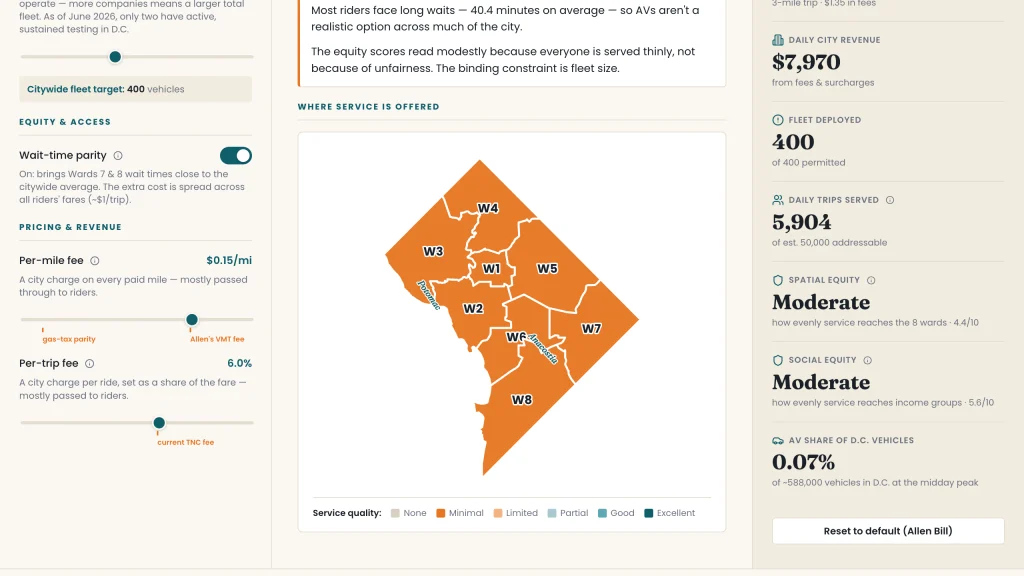
Mobility Mayor

You’re the mayor. Set caps on autonomous vehicle fleets, the per-mile fee, the per-trip fee, and whether every ward gets service parity – and see how each impacts trip costs, equity, wait times, and city revenue across all eight wards.

What it shows Why a fleet cap and an equity mandate may pull in opposite directions, and why the answer depends heavily on one number operators don’t disclose.
Game In development

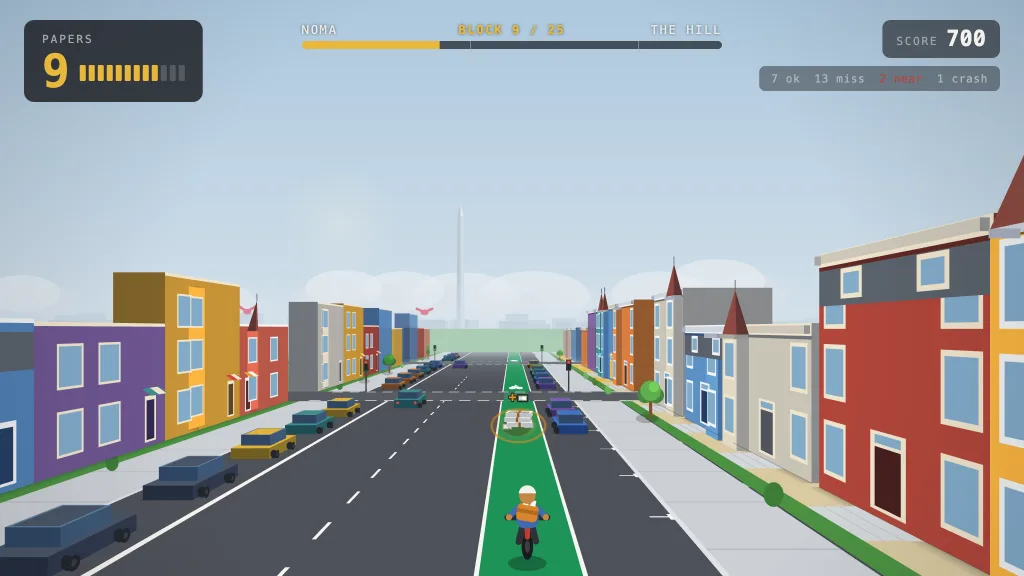
DC Courier

You're a bike courier delivering goods in three DC neighborhoods, based on real street designs: painted bike lanes, no bike lanes, two lane roads, and four lane roads. Avoid double-parked delivery trucks, right hooks, and doors.

What it shows Safety for vulnerable road users is heavily influenced by the built environment and driver behavior.
In development — expected 2026
Strategy game In development

Safe System (working title)

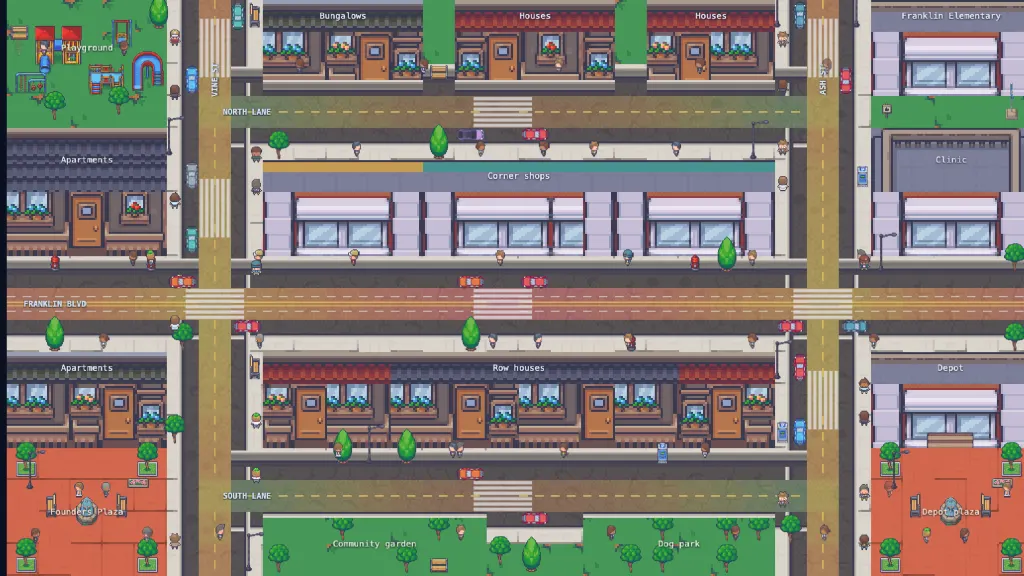
A layered-defense game built on the Safe System approach. Speed management, road design, vehicle standards, road-user behavior, and post-crash care each stop some share of risk — and none of them is sufficient alone.

What it shows Why redundancy is the whole point: any single layer you rely on will eventually be the one that fails.
In development

How we build these

Every experiment starts with a complex technology or policy, and a question: can we help people understand this better and inform thoughtful decisions?
  1. Identify a knowledge gap. We're interested in advancing public understanding about topics related to safety, livability, or opportunity.
  2. Understand the core mechanics. We research the problem that needs to be addressed, the range of solutions, and the tradeoffs that could be better understood.
  3. Build the prototype. We decide on whether to build an interactive dashboard or immersive experience, then use artificial intelligence tools to rapidly prototype and iterate. Before AI, an initial prototype would've taken weeks or months, but we can test several hypotheses in hours.
  4. Refine for impact.Testing and refinement is the most important part of our development process. We thoroughly evaluate each experiment for its educational value, how enjoyable it is to use, and how plausible it is before it is released to the public.
  5. Share with the world.When a completed experiment meets IMI's standards, it is made freely available to the public on this website. In the interest of advancing this medium, we plan to write articles about some experiments that didn't pan out and explainers of our development process.

Use these in a classroom

Everything in Policy Labs is free, requires no account, and (should) run in a browser on a Chromebook. If you teach planning, public policy, civics, or related disciplines, you’re welcome to use these however you like – no permission needed.

In the future, we hope to build teaching notes and discussion prompts for each experiment. If you’d like them as they’re finished, or you want to tell us what would make these more useful in your classroom, get in touch.

Sign up for the newsletter.

Our Substack newsletter provides regular updates and analysis about what's shaping the future of transportation, urbanism, and policy.

Subscribe on Substack → Free. Unsubscribe in one click.